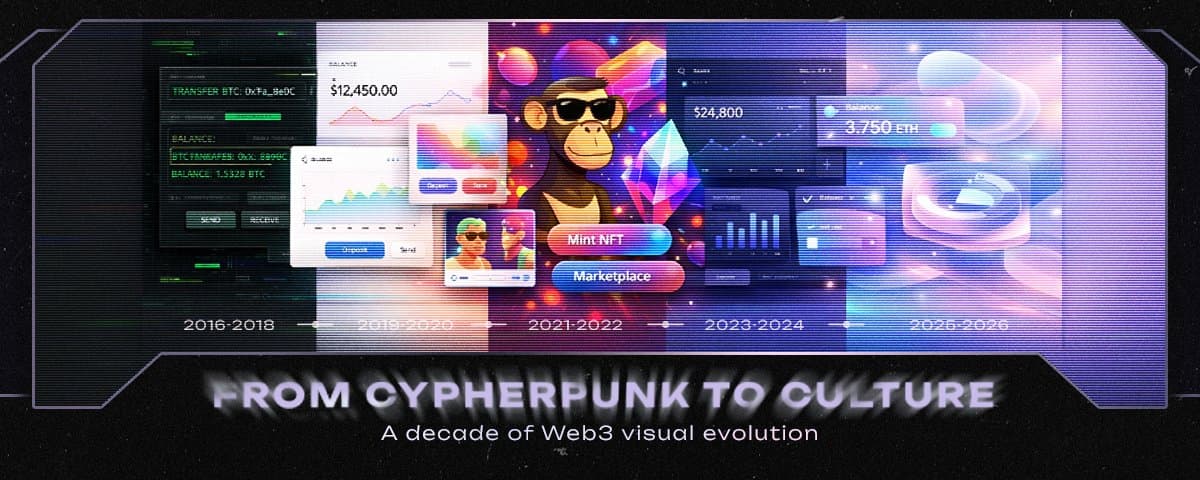
A Web3 Visual Language Timeline: 2016 – 2026
Web3's visual language from 2016 to 2026 closely reflects the evolution of crypto culture, underlying technology, and market cycles. Over time, it has shifted from an underground, developer-focused aesthetic to a polished, highly branded, almost luxury-level design style.
In many ways, the mindset of Web3 has always been visible through its design: across user interfaces, profile pictures (PFPs), NFT art, websites, and content. Broadly, we see the space as having moved through three stages:
From “terminal for rebels” to “casino for creators” to “infrastructure for digital identity.”
The challenge now is applying this visual evolution to enable better products. How that happens will vary by project, but one clear direction is the growing importance of identity (both individual and collective) expressed through design. If past trends are any indication; clean, minimal branding will continue to spread through creator ecosystems and help drive user adoption and retention. Creators who understand this visual history will be best positioned to shape the next decade of Web3. So let's break it down.
The Three Main Phases of Web3 Visual Design
1. Crypto-Native Phase (2016–2019)
This early era was dominated by developers and crypto enthusiasts, and the design reflected that reality. Interfaces were dark, often built around black, deep blue, or terminal green. Typography leaned heavily on monospaced, code-like fonts, while glitch effects and low-fidelity graphics gave products a raw, experimental feel. Anonymous symbols like masks, hoodies, and abstract icons were common, and the overall aesthetic drew heavily from cypherpunk and hacker culture.
The tone was anti-establishment, technical, and deeply distrustful of institutions. It looked this way because the community valued privacy, decentralization, and builder culture far more than mainstream usability.
2. Speculative Phase (2020–2022)
This period coincided with the explosion of NFTs and a wave of mainstream attention. Visual design became louder, brighter, and more performative. Neon gradients, holographic textures, chrome surfaces, liquid forms, cartoon avatars, and PFP culture all became defining features of the era. Interfaces often used glass morphism, floating UI layers, psychedelic palettes, and busy, high-energy compositions.
The tone became far more playful, chaotic, speculative, and status driven. Design during this phase wasn't just trying to communicate utility, it was trying to go viral, capture attention, and signal upside.
3. Utility / Mainstream Phase (2023–Present)
After the market cooled and volatility reshaped the industry, projects began shifting toward credibility and usability. Layouts became cleaner, color palettes became calmer, and typography became more structured and professional. Real-world imagery such as products, communities, and events started appearing more frequently, while motion design became more subtle and restrained.
The tone became more focused on trust, stability, and enabling users and communities. Projects needed to build confidence, appeal to broader audiences, and show they were capable of delivering real products rather than just hype. But there's something else we noticed over the last 10 years or so:
A Deeper Evolution (2016–2026)
Looking more closely, Web3 design didn't just move through three broad phases. It evolved across five more specific stages.
2016 to 2018: Web3 design was deeply rooted in the crypto underground. It was raw, experimental, and heavily influenced by hacker culture. Most of it was functional, but it wasn't especially user-friendly.
2019 to 2020: Cleaner and more minimal protocol design began to emerge. Interfaces started borrowing from SaaS design patterns, and projects began to look more like legitimate products rather than niche experiments.
2021 to 2022: The NFT boom pushed design into a highly expressive and chaotic phase. Art, identity, and community became central to the user experience, and visual experimentation exploded.
2023 to 2024: The market's reset drove a wave of brand consolidation. Projects moved toward clarity, trust, and professionalism. Design became more restrained, more intentional, and more product oriented.
And finally, starting in 2025 and into 2026, a new phase is beginning to take shape. Web3 design is increasingly blending with AI and spatial computing. The emerging style is defined by soft atmospheric gradients, immersive 3D-like environments, generative visuals, adaptive branding, and interfaces that feel dynamic and alive. The tone is calmer, more intelligent, and more responsive. It's less about hype and more about systems that feel ambient, intuitive, and alive in real time.
The Rise of Identity as Design
As AI becomes more pervasive, one of the most important shifts in Web3 is the way data is treated, not just as information, but as an extension of the individual.
Over time, wallets have evolved from developer tools into identity hubs. Dashboards have moved from raw data displays to adaptive environments. Interfaces have become more personalized, expressive, and reflective of the user behind them.
This points to a deeper truth about Web3: users don't just use products, they embody them.
You can see that clearly in the evolution of core product components. Buttons have moved from raw command inputs to clear actions, then to hype-driven interactions, and now to calm, contextual experiences. Wallets have evolved from developer utilities into usable apps, then identity layers, and now toward intelligent agents. Dashboards have gone from data dumps to structured views, then overloaded visual experiences, and increasingly toward adaptive systems.
The Role of Creatives in Web3
As Web3 has matured, creatives have become central not just to marketing, but to the product itself.
In traditional industries, design usually promotes the product. In Web3, the creative output often becomes part of the product. That became especially obvious during the NFT boom, when independent artists played a major role in shaping ecosystems, communities, and cultural momentum.
Over time, projects have gotten better at channeling that creative energy. The move toward minimal, composable design systems also suggests a broader economic direction: simpler visuals can support more flexible, scalable experiences.
Now that AI is entering the space, the creative possibilities are expanding again. Generative design, adaptive branding, and personalized interfaces are setting the stage for the next phase of Web3 products and identities.
So Where Is This All Going?
Web3 brands are increasingly behaving like entertainment companies. They're investing in storytelling, culture, and creator ecosystems because they understand that adoption won't be driven by technology alone. It will be driven by experience, identity, and the emotional connection users feel to the products they choose.
The visual history of Web3 is more than a design trend. It's a preview of a decentralized, identity-driven future.
The open question is simple:
What will your identity look like in that world?
Shoot Radiant Labs a DM, and we'll help you create it.
Follow Radiant Labs for more insights on Web3 marketing, community building, and creative experiments.
Follow @RadiantLabsHQ on X →