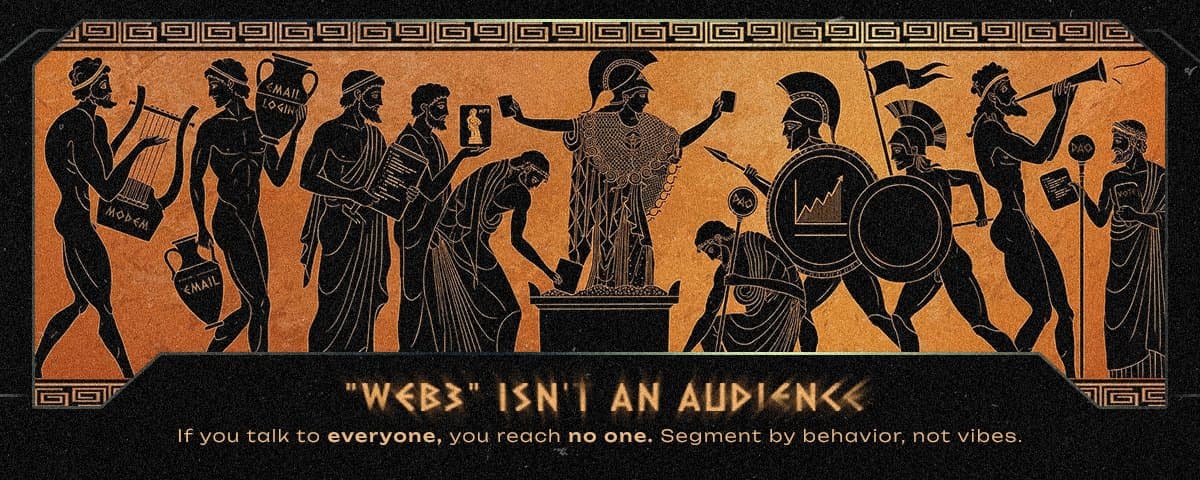
“Web3” Is Not One Audience, and It Never Has Been
A common mistake we've seen plague web3 marketing teams is the misconception that “web3 users” are a single audience. But based on our continued research and experience, they contain multitudes.
Web3 is made up of different behavioral groups with different motivations, risk appetites, communication styles, and reasons for showing up. Primarily there's traders, builders, and creators. And let's be real; some simply want access, status, ownership, or community. They may all exist in the same ecosystem, but they rarely respond to the same message (Undeniable bangers aside).
That matters WAY more than most teams realize. Think about it: When you talk to everyone the same way, your message loses relevance. Why? Well, a builder might get your technical tweet but a new user might be completely scared away by the perceived complexity of what they're getting into. In turn, your positioning gets weaker, content gets generic and you become one of those projects that has a “meh” timeline and little interest.
The teams that build lasting traction are the ones that understand who they're speaking to, what those people care about, and how to meet them in a way that actually resonates. And this is where we feel audience strategy starts.
Why Web2 Thinking Breaks in Web3
A lot of traditional marketing still assumes scale comes from broad reach and broad messaging. That model made sense in Web2, where platforms were built around centralized distribution, standardized user flows, and mass-market behavior. Brands could group large numbers of users together, push the same message out widely, and rely on platform algorithms and paid channels to do the rest.
Web3 is different. This space is more participatory, more incentive-aware, and more behaviorally distinct. Users aren't just customers moving through a funnel. They are often holders, contributors, speculators, builders, community members, and evangelists all at once. In other words, their direct investment in the product and its growth make them a wholly different type of audience.
They move between ecosystems quickly, pay attention to signals and respond to culture. But they're also looking for credibility, utility, timing, and identity. That means audience strategy in Web3 has to go deeper than broad categories or surface-level demographics and that means getting behavioral with it.
Enter: Archetypes
The real shift is this: Archetypes matter more than perceived “Users” when developing your strategy. When you stop thinking in terms of one audience, you can start thinking in terms of archetypes. Archetypes help you identify the major behavioral segments inside your ecosystem. They're typically broad but very useful categories that explain how different people/users engage with Web3. For example, your audience may include:
- Traders
- Builders
- Content Creators
- Filthy Degens
- DAO participants
- Collectors
Each of these groups has different goals and different expectations but most importantly, they react to different signals. A trader may care about speed, opportunity, edge, and timing. Builders may care about tools, infrastructure, credibility, and long-term upside. The creator may care about visibility, identity, collaboration, and cultural relevance.
So what do you notice? These aren't small differences. They shape how people interpret your product, your messaging, your content, and your calls to action. If you treat all of them the same, you're shooting yourself in the foot.
From Archetypes to Personas
Once you understand your archetypes, the next step is turning them into personas. While an archetype is a broad audience segment, a persona is a more specific example of someone within that segment. Think of it this way:
Archetype: Trader
Persona: Full-time altcoin trader, active on X and Discord, high risk tolerance, checks charts constantly, responds to speed, product edge, and market timing
Or:
Archetype: DAO contributor
Persona: Holds multiple governance tokens, votes regularly, spends time in Discord, cares about influence, transparency, and long-term alignment
Personas make your audience usable. They help you shape channel strategy, tone, framing, content format, and product positioning around real patterns of behavior rather than vague assumptions. This is where stronger marketing comes from. You don't need to get LOUDER, you just need more streamlined messaging. Scalpel not a sword.
Better Segmentation Creates Better Growth
One of the biggest misconceptions in Web3 is that growth is chaotic. It's not though. The best campaigns are highly structured. Growth happens through community expansion. Communities split into subgroups, form identities, and stay connected through shared channels and ecosystems. What might look messy from the outside usually has a very followable pattern underneath it. And THAT is why segmentation matters so much.
When you understand which archetypes exist in your audience, you can do everything from framing your product in the most relevant way, choose the correct channels for the correct people, and build messaging that scales more effectively.
This is also what creates better retention. People come back when they feel understood. Relevance builds trust. Trust builds repeat attention. And repeat attention is what turns audience into community.
So what? Why does this matter? Well, for teams straddling the line of both Web2 and Web3, this is one of the most important mindset shifts to make. Forget “marketing” as a monolith. Think of it more as a behavior-rich environment where identity, incentives, and context all shape audience response.
Here are some common brand struggles we've noticed with web3 marketing:
- Talking to everyone in the same tone
- Reuse the same message across every audience segment
- Copy competitors instead of developing a real position
- Mistake hype for strategy
Winning brands on the other hand tend to identify behavioral groups early, learn what each segment values and adapt their messaging without losing brand consistency.
Ultimately, the real takeaway here is that Web3 will continue to NOT be one audience and will likely fracture even further as prediction market prominence starts to take hold. The better you understand those distinctions, the better your strategy becomes. The right user, with the right message, in the right moment, creates stronger growth than broad messaging ever will.
At Radiant Labs, we believe that's where the true work is in marketing. The more clearly you can define who you are speaking to, the more effective your positioning, content, and creative become. That's the first step.
If you're building in Web3 and want to sharpen your audience strategy, DMs are always open.
Our next segment will break down one of the most important Web3 audience types: the creative archetype, and the personas around it. Stay radiant 🌟
Follow Radiant Labs for more insights on Web3 marketing, audience strategy, and creative experiments.
Follow @RadiantLabsHQ on X →