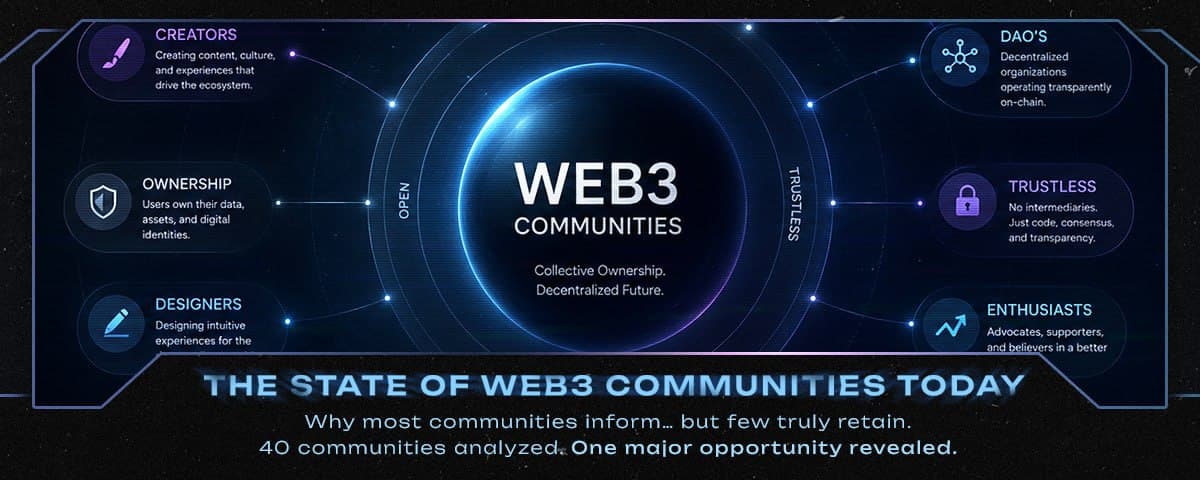
The State of Web3 Communities Today
Radiant Labs Web3 Community Audit
Unlike traditional Web2 platforms—where users mainly interact with a product owned by a centralized company—Web3 communities are much more integrated into the life of a project. Users are not just customers or data sources; they can actively participate in shaping the product, contributing ideas, and even influencing its direction. In many cases, the community becomes just as important as the product itself.
Radiant Labs, the creative arm of Phoenix focused on Web3 marketing and culture, conducted an in-depth audit of 40 Web3 communities. Our findings highlight a major opportunity for the next phase of Web3: transforming functional community hubs into vibrant, engaged ecosystems that drive long-term retention and growth.
Key Insight
Most Web3 communities today function more like operational dashboards for protocols rather than dynamic, self-sustaining communities. While they are effective at sharing information, they often fall short in fostering meaningful engagement and participation.
Common Weaknesses
The audit revealed several recurring issues across projects:
1. Shallow engagement
Many communities have large member counts but low activity. Conversations are often limited to basic support questions or users trying to “farm” rewards, rather than meaningful discussion.
2. Weak onboarding
New users frequently lack clear guidance. There is often no strong “start here” experience, making it difficult for newcomers to quickly understand how to participate.
3. No contributor pathway
Few communities offer a clear progression from casual user to active contributor, ambassador, or power user. Recognition systems are often missing or underdeveloped.
4. Underdeveloped user-generated content (UGC)
Channels meant for sharing content—like memes, research, or dashboards—are often inactive. Systems that encourage users to create and contribute content are not well built.
5. Lack of culture
Community participation rarely evolves into a distinct culture. Interaction tends to stay transactional rather than becoming identity-driven or expressive.
6. Community-to-growth gap
While communities provide value for existing users, they are not effectively leveraged for growth. There are few recurring events (like AMAs), limited programming, and little connection between community activity and marketing or product development.
7. Inconsistent security practices
Basic security measures—such as clear official links, scam warnings, and anti-phishing reminders—are often missing or inconsistently applied.
What Strong Communities Do Well
A smaller group of standout communities showed what's possible when things are done right. These communities combine structure, active management, and real user engagement to support long-term growth.
Common strengths include:
1. Clear structure
Channels are well-organized, with easy-to-find rules, FAQs, and official resources. Users can quickly navigate and get help when needed.
2. Consistent communication
Teams provide regular updates, clear announcements, and maintain an active operational presence.
3. Product-focused discussion
Conversations are driven by real usage—trading, staking, liquidity provision—rather than generic chatter. This leads to higher-quality interactions.
4. Responsive support
Moderators and team members actively respond to users, building trust and reliability, especially during issues or high-traffic moments.
These communities are not perfect, but they demonstrate a working model for sustainable growth.
Notable Examples
Projects that stood out in the audit include:
- Midas
- Polymarket
- Meteora
- Hyperliquid
- Aster
- Quickswap
The Opportunity Ahead
The biggest opportunity in Web3 community building is clear:
Move beyond functional hubs and build engaged, culture-driven communities.
Projects that succeed in this shift will not only improve user retention but also unlock new forms of growth—where community members become contributors, creators, and advocates.
The next wave of Web3 innovation won't just be technical—it will be social.
Follow Radiant Labs for more insights on Web3 marketing, community building, and creative experiments.
Follow @RadiantLabsHQ on X →