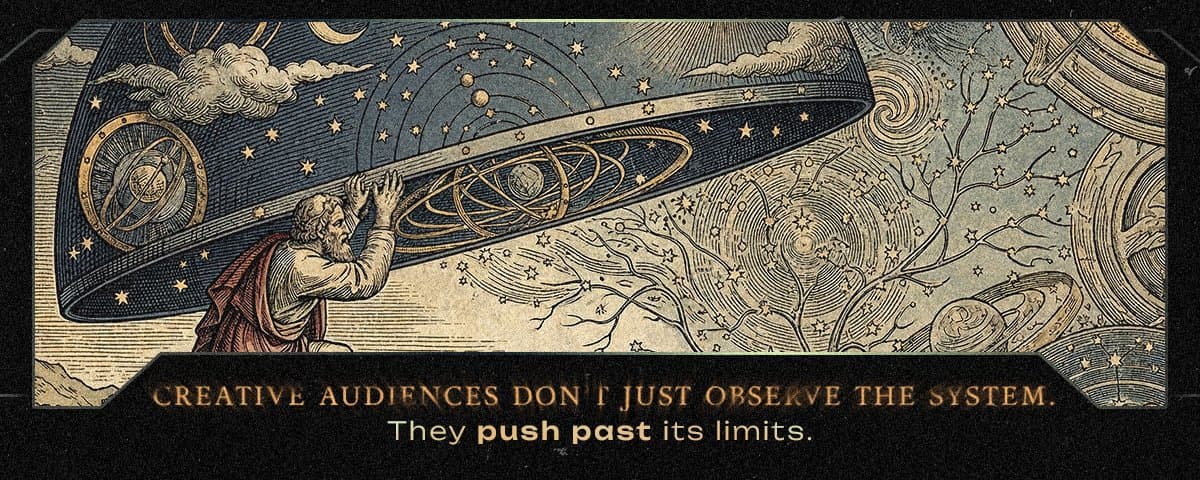
The Creator's Creation: A Total Reshaping of the Marketing Funnel
The word “creator” has gained so much prominence in the last 10 years or so, that it often gets tossed around rather loosely.
Sometimes it means artists. Sometimes it means influencers. Sometimes it means developers, meme makers, community leaders, or anyone producing content around a project. The result is that “creators” often get treated as a vague category of helpful online people rather than a distinct force inside an ecosystem.
That lack of clarity matters, because if creators aren't clearly defined, it becomes hard to explain why this archetype matters so much.
Put simply, a creator is a lot more than someone who posts or produces content.
A creator is someone who generates meaning, attention, or participation around a project in a way that goes beyond ordinary use. They don't just consume the product or repeat the official message. They interpret it, extend it, and make it more legible, engaging, or usable for other people.
That can include everyone from artists to developers and writers, to video editors and meme wizards. In essence, they're highly engaged users who consistently turn passive interest into shared activity. What makes them creators is not the medium they work in. It's the function they perform, which is exploring new ways for people to understand a project, talk about it, and stay connected to it.
So why does that distinction matter? Because while normal user interacts with a product as it's presented, a creator tends to interact with it by producing something around it that provides value: a narrative, a tutorial, a meme, a data tracking tool: ultimately a cultural signal others can recognize and rally around.
Creators are both navigating the system, as well as making that system easier for others to enter and navigate themselves.
And THAT is ultimately why creators matter so much in Web3: because growth is rarely as straightforward as teams want it to be.
Most projects still think about growth in funnel terms. How do you get attention? How do you convert awareness into belief, and belief into participation? For many teams, the answer is some version of the founder funnel, where the founder becomes the narrative engine, using visibility, credibility, and a strong point of view to pull people into the project.
And that model can work! Especially early on. Founder-led momentum is often powerful.
But at the same time, it has clear limits. A founder funnel can generate attention without generating attachment. It can bring people in without giving them a meaningful reason to stay.
Enter: Creators
Creators go beyond just amplification. They're translators, making understanding easier for the uninitiated. They transform info into formats other people can actually recognize, engage with, and repeat. A founder may explain the vision, but creators are often the ones who make that vision take flight.
In our eyes, that's why they shouldn't be treated as a marketing accessory or a layer of polish added after launch. These are not just disposable assets used to fill a content calendar and make the brand look active, or drive engagement. At their best, creators expand the number of ways a project can be entered, understood, and grown. And that changes the shape and trajectory of a project.
Let's Break It Down Even Further
A traditional funnel assumes a clean path: awareness at the top, conversion at the bottom. But Web3 rarely behaves that neatly. Communities are fragmented, participatory, and shaped in real time by the people in them. The path from attention to commitment is almost never a straight line.
Creators make that path even more dynamic because they don't simply help guide people through the existing funnel. They bring in people through art, humor, and subculture. They attract participants who may never have responded to the founder's original message. They create alternate entry points the project itself may never have designed.
That's what we mean when we say creators reshape projects.
To be clear, creators don't singlehandedly determine success. BUT once creators begin building around a project, the project is no longer being shaped only by its founders, roadmap, and incentives. It's also being shaped by the people producing meaning and participation around it. That becomes especially important after a project launches.
A huge swath of Web3 growth still depends on spikes of attention: token launches, announcements, partnerships, incentive campaigns, roadmap reveals. These moments can bring people in, but they don't always create durable attachment. When the excitement fades, many projects discover that they generated traffic, but not a committed, vibrant userbase. This is another gap Creators help close.
They create continuity between the big moments and moves. They keep communities active between launches and give people reasons to care that aren't purely transactional. They help transform projects from something a user tries into a community.
Another big question to consider is how AI is used in the creator space. AI can increase content volume. It can accelerate output and visibility. But visibility is not the same as meaning, and output is not the same as identity. A project can produce constant activity and still feel culturally empty.
Creators do something harder to automate. They create interpretation. They're tastemakers who create signals that people recognize as worth following.
Some do that through aesthetics and collectability, others through governance and collaboration. They aren't all the same kind of participant, and they might not shape a project in the same way. But they share one critical function: they make the project more meaningful, accessible, or compelling to someone beyond themselves.
That is why creators have become essential to the infrastructure of growth.
Founders often recognize the surface-level value creators bring.
More attention.
More content.
More visibility.
More social proof.
But the deeper value is structural. Creators do not just amplify momentum. They give it shape. They widen the funnel, deepen the culture, and create reasons for people to remain involved after the original pitch has done its job.
In a market defined by volatility and short attention spans, that kind of durability matters.
Follow Radiant Labs for more insights on Web3 marketing, audience strategy, and creative experiments.
Follow @RadiantLabsHQ on X →